
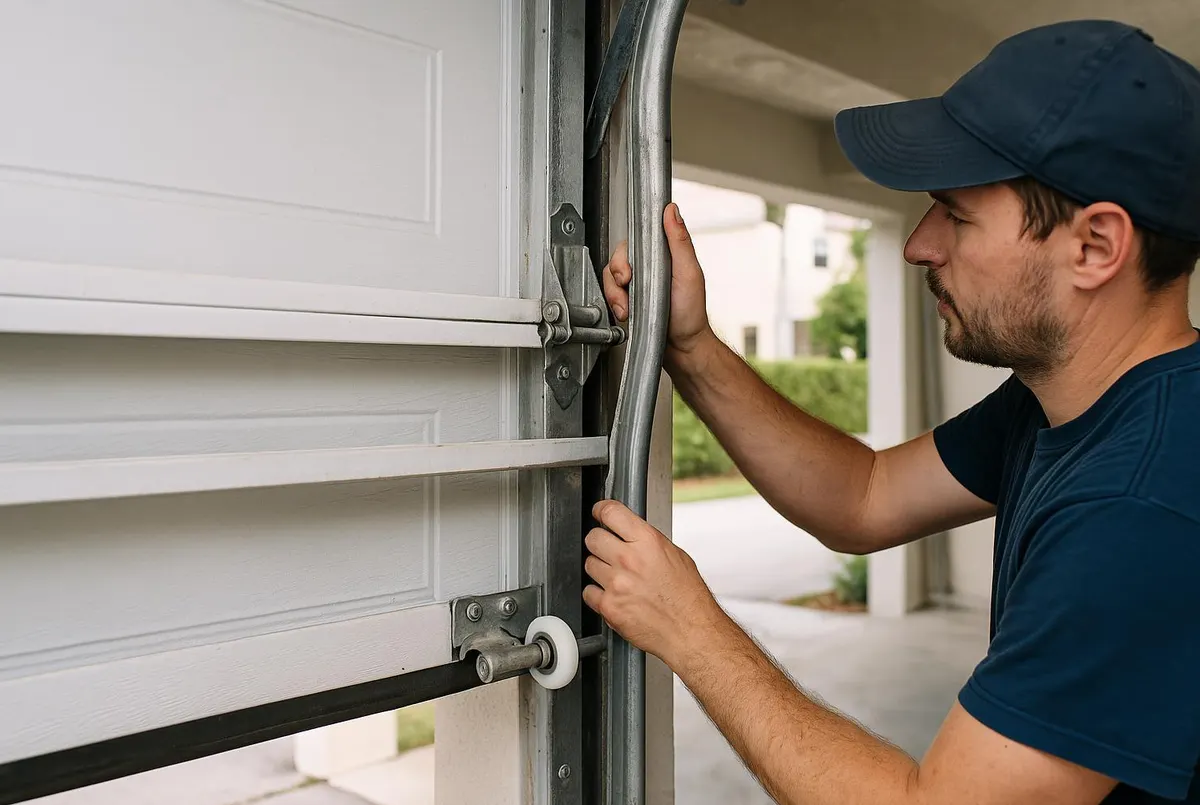
What a Technician Sees on This Call
This is one of the most common service calls across Collier County this time of year. A homeowner presses the remote or wall button, the door starts down, travels a foot or two, then stops and reverses back up on its own. Or the door won't budge at all — the opener motor hums or clicks, but nothing moves. Sometimes it's intermittent: the door closes fine in the morning but reverses every afternoon once the sun has baked the driveway and the humidity climbs. That pattern alone tells a technician a lot before they even open the panel, because heat, moisture, and salt air all play a role in how these systems behave here.
The Symptoms Homeowners Usually Describe
- Door closes most of the way, then reverses a few inches before reaching the floor
- Door reverses the instant it touches the floor or weatherstripping
- Door won't move downward at all, opener motor runs but the carriage doesn't travel
- Problem happens mainly after rain or during the hottest part of the afternoon
- Remote works but the wall button behaves differently, or vice versa
- Opener light blinks a set number of times when the issue occurs
Each of these points toward a different stage in the system, which is why a technician works through the checks in a specific order rather than guessing.
1. Safety Sensors First — Because They're the Fastest Fix
The photo-eye sensors mounted low on each side of the track are the first thing checked, because they're the most common cause and the quickest to rule out. If the sensors are misaligned, dirty, or have condensation on the lenses — which happens often here given the humidity swings between sun and afternoon downpours — the opener reads it as an obstruction and reverses the door. Coastal salt air can also corrode the sensor brackets or wiring connections over time, causing an intermittent signal that only acts up in certain conditions. The fix is usually straightforward: clean the lenses, realign the sensors so both LED indicators glow solid, and check the wiring for corrosion or a loose connection at the terminal.
2. Tracks and Rollers
Next, a technician runs the door manually (disconnected from the opener) to feel for binding. Humidity causes wood-framed doors and even some steel panel sections to swell slightly, which can tighten the fit inside the tracks. Rollers exposed to salt air or repeated rain exposure near the bottom of the track often develop rust or flat spots, creating resistance the opener interprets as an obstruction. This gets fixed by cleaning out debris, lubricating the rollers and hinges with a silicone-based lubricant (not household oil, which attracts grit), and replacing any rollers that are pitted or no longer spinning freely.
3. Opener Force and Limit Settings
If the sensors and rollers check out, the next step is the opener's force and travel-limit settings. These are factory-set but drift over time, and seasonal changes in door weight or track friction — again, often tied to moisture — can throw them off enough that the opener's resistance threshold triggers a reverse before the door is actually stuck. Adjusting the down-limit and force settings according to the opener's manual, then running several test cycles, usually resolves this. It's a simple fix but an easy one to get wrong, since setting the force too high defeats the safety reversal feature entirely.
4. Spring Balance
A door that's out of balance because of a weakening torsion or extension spring puts more strain on the opener than it's designed to handle, and the opener may reverse partway down as it struggles against the extra resistance. The test here is simple: disconnect the opener, lift the door manually to about waist height, and see if it holds its position. If it drops or shoots up, the spring is no longer doing its job. Spring replacement is not a DIY job — these are under heavy tension — but once replaced and properly balanced, this type of reversal issue typically disappears for good.
5. Bottom Seal and Weatherstripping
After heavy rain, a swollen or warped bottom seal can catch on the garage floor or a threshold seal, creating just enough resistance to trip the reversal sensor right at the end of the cycle. This is common after the kind of sudden afternoon downpours that roll through from June through November. Trimming or replacing the bottom seal, and checking that the floor beneath it is clear of debris or standing water, usually clears it up.
6. Opener Electronics
If none of the above explains it, the issue may be in the opener's logic board or capacitor — more likely on an older unit that's been running through several hurricane seasons of power surges and humidity. At this point, a full diagnostic on the opener itself is warranted, and depending on its age, repair versus replacement becomes a real trade-off to weigh.
When to Call Naples Garage Door Pro
If you've checked the sensors and seal yourself and the door still won't close reliably, it's time to call in a technician rather than keep adjusting settings by trial and error — especially if a spring is suspected, since that repair involves stored tension that isn't safe to handle without the right tools. Naples Garage Door Pro handles this exact call regularly throughout Naples, Bonita Springs, Estero, and the rest of Collier County, working through sensors, track alignment, spring balance, and opener diagnostics until the door closes smoothly and stays closed. We offer Garage Door Repair and Spring Replacement for exactly this kind of issue, along with opener service if the electronics turn out to be the culprit.
If your garage door is reversing, sticking, or won't close at all, call Naples Garage Door Pro today and we'll get it diagnosed and fixed right.